

Table of Contents
- Top Rookie Prospects to Watch in 2026
- Key Rookie Card Sets for 2026
- Autograph vs. Base Card Value
- How to Grade Sports Cards for Maximum Value
- Best Sports Card Investment Strategies for 2026
- How to Store Rookie Cards to Protect Your Investment
- Frequently Asked Questions
Last Updated: September 15, 2026
Top Rookie Prospects to Watch in 2026
The best rookie cards to collect in 2026 reward collectors who scout talent before the market catches on. This guide breaks down which prospects, sets, and strategies actually hold value, because chasing hype without a plan is how most collectors lose money.
Building a rookie card collection is part talent evaluation and part timing. The collectors who profit consistently are the ones who buy into a prospect's first Bowman or flagship rookie card before a breakout season, not after the highlight reel hits every feed. A common mistake is overpaying for a base rookie card during peak hype, then watching the secondary market cool once the season ends (psacard.com).
Here's the framework serious prospectors use:
- Scout before the call-up. Watch minor league and college tape, not just box scores.
- Target first-year cards. A player's rookie debut card carries more collector value than a second-year reprint.
- Check the pop report. A low population of graded copies signals scarcity worth paying for.
- Buy the dip, not the spike. Market valuation on prospects swings hard with a single hot streak.
The prospects worth tracking in 2026 are the ones with a clear path to playing time and a card already anchored in a major set. Names change every season; the evaluation process does not.
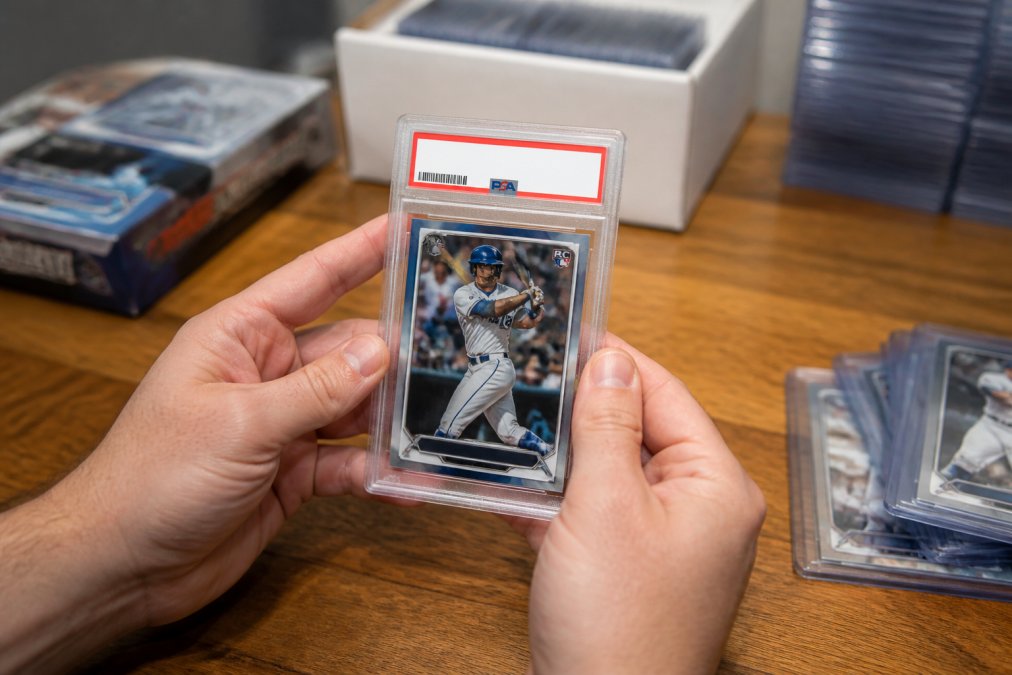
Key Rookie Card Sets for 2026
The best rookie card sets to collect in 2026 fall into two camps: flagship base sets with broad appeal and premium hobby-exclusive releases with limited print runs. Knowing which is which determines whether you're buying a long-term hold or a short-term flip, and the biggest mistake collectors make is treating every shiny release as if it carries the same staying power.
Flagship sets anchor most collections because they're widely recognized and easy to resell. Hobby boxes typically offer better odds at autographs and serial numbered parallels than retail, though retail blasters remain a cheaper entry point for budget-conscious hobbyists. First Bowman cards for baseball prospects and flagship rookie debuts for football carry the strongest collector value when a player breaks out.
Here's how the major 2026 product families break down by role in a portfolio:
| Set Type | Best For | Key Draw | Buy If |
|---|---|---|---|
| Flagship base set (Topps Series 1/2/Update, Panini Prizm) | Long-term hold | Broad recognition, easy resale | You want liquid, well-known cards |
| Hobby-exclusive release (Bowman Chrome, Panini National Treasures, Topps Chrome) | Autograph chasers | Serial numbered parallels, short prints | You want scarcity and upside |
| Retail blaster | Budget entry | Lower cost per pack | You're testing the waters |
| First Bowman (baseball) | Prospect investors | Earliest licensed card of a player | You're betting on a breakout |
| Update/Traded series | Late-season flippers | Rookies who debut mid-season | You want in before the offseason hype cycle |
A few mechanics worth understanding before you buy:
- Flagship release windows. Baseball flagship typically rolls out in waves across the spring and summer, with an update series landing in the fall to capture late call-ups. Football flagship and Prizm-style releases cluster around the start of the NFL season. Buying the base rookie during the initial release window is usually cheaper than waiting for a breakout.
- Chrome vs. paper. Chrome and refractor stock holds up better to handling and grading than paper base, which is why a gem-mint Chrome rookie often outsells the equivalent paper card by a wide margin.
- Parallel tiers. Within a single set, a numbered parallel (say, a low-print refractor) can outperform the base version of the same card by multiples. The tier matters as much as the player.
- First Bowman timing. For baseball prospects, the First Bowman card is often the earliest licensed card a player appears on, which is why it can trade above the flagship rookie even before a call-up.
Set selection is a portfolio decision, not a loyalty decision. A balanced approach pairs one or two flagship anchors per sport with a small allocation to hobby-exclusive upside plays, so a single bad product year doesn't sink your collection.
Autograph vs. Base Card Value
An autograph rookie card is almost always worth more than its base counterpart, but the gap depends on scarcity and authentication. A certified on-card autograph from a major set holds value far better than a sticker autograph or an unverified signature (psacard.com).
The reason is simple: scarcity and trust. A serial numbered autograph with a low print run gives buyers a concrete supply figure, while a base card's print run is often unknown. Short print autographs can command multiples of a base rookie card's price, especially for a top prospect. What most guides miss is that a graded base card in mint condition can sometimes beat a raw autograph, because condition and grading service reputation carry real weight in the secondary market.
The takeaway: buy autographs for upside, buy base cards for stability, and never assume a signature alone guarantees value.
How to Grade Sports Cards for Maximum Value
Grading sports cards is the process of submitting a card to a professional grading service for authentication and a condition score. The score, or grade, directly affects market valuation, and knowing how to grade sports cards well is what separates a profitable submission from a wasted fee.
The major grading services evaluate four things: centering, corners, edges, and surface (psacard.com). A card that scores in the investment grade range (typically a high mint grade) can sell for far more than the same card raw. Before submitting, inspect under good lighting and compare against the grading service's published standards.
- Check centering front and back with a centering tool
- Inspect all four corners under a magnifier
- Run a finger along the edges for nicks or chipping
- Look for surface scratches, print lines, or dimpling under angled light
- Compare your estimate against recent graded sales before paying the fee
The grading ROI math most guides skip
This is the part competitors gloss over: grading is a capital allocation decision, not a rite of passage. Every submission ties up money in fees and shipping for weeks, and the return depends entirely on the spread between the raw price and the graded price at the grade you actually expect, not the grade you hope for.
The framework:
- Look up recent raw sales for the exact card (same year, set, parallel, and player).
- Look up recent graded sales at the grade tier you realistically expect, not the gem-mint outlier.
- Subtract the grading fee, shipping both ways, and any insurance from the expected graded price.
- Compare that net number to the raw price. If the net doesn't clearly beat raw, don't submit.
A common pattern: grading pays off on key rookies, short prints, and low-numbered parallels, where the graded premium is large enough to absorb the fee.
Raw vs. slab: which side of the trade are you on?
Condition red flags that kill a grade
Best Sports Card Investment Strategies for 2026
How to Store Rookie Cards to Protect Your Investment
Frequently Asked Questions
What rookie cards should I look for in 2026?
Focus on first-year cards from top prospects in MLB and NFL, especially those in flagship sets like Topps Series 1 and Prizm. Look for short prints, serial-numbered parallels, and autographed versions. Also watch for players with strong rookie debut performances. Always check the checklist for release dates and chase cards, and consider grading service options for high-value pulls.
How do I determine the value of a 2026 rookie card?
Value depends on player performance, scarcity, condition, and market demand. Check recent sales on the secondary market, review pop reports for graded cards, and compare raw vs. slabbed prices. Autographs and low-numbered parallels typically command more. Use market valuation tools and consult checklists to identify short prints and first Bowman cards, which often hold collector value.
Are 2026 Topps Series 1 and 2 cards good investments?
They can be, especially for rookie debut cards of breakout stars. Flagship sets have wide appeal and liquidity. However, base cards are mass-produced, so focus on parallels, autographs, and short prints. Grading high-condition cards can boost value. For long-term hold, target players with strong fundamentals. Always consider portfolio diversification across sports and eras.
What factors make a rookie card worth collecting?
Key factors include player potential, card scarcity (serial numbered, short print), condition (mint condition), and set prestige. Autographs and memorabilia add value. Rookie debut cards and first Bowman are highly sought. Also consider market trends and investment grade. Proper storage and grading can preserve and increase value over time.
Building a rookie card collection that actually grows in value takes discipline, the right sets, and proper storage from day one. Dinger Card Shop carries graded and raw sports cards, hobby boxes, packs, protective supplies, and a curated selection from Drew's Personal Collection, all shipped with secure packaging and tracking. Whether you're hunting a First Bowman prospect or a vintage favorite, get started with Dinger Card Shop and build a collection that holds its value.